
Art Insights
This page is designed to preview a ideas for exhibitions and print
BIO
Julianne Chladny is a multifaceted artist, author, and entrepreneur based in Vancouver, Canada. She holds a BFA from the Emily Carr University of Art and Design, a diploma from the Victoria School of Visual and Performing Arts, and continued studies at prestigious institutions like Harvard University, HCC College, Metro Community College, and The Red Cross. Julianne has participated in numerous group events such as SWARM, The Eastside Culture Crawl, a Congolese Cultural Revitalization event, and more recently The Art Walk West of Main. She also been awarded Artist-In-Residency for the Hammock Residency and through her employer, PosAbilities. In addition showing in galleries and for outdoor beautification events, she has worked with art collectives such as Instant Coffee, Artists In Our Midst, Generation WTF, and ie CRU, and has some extensive volunteer experience.
Projects
Julianne is currently the artist-in-residence with her employer PosAbilities and will be exhibiting at Alternatives Gallery, February 16 - 27 2026. The reception will be held February 26th at 6:00 - 8:00pm,
1659 Venables, Vancouver BC
Ideas/Future Series
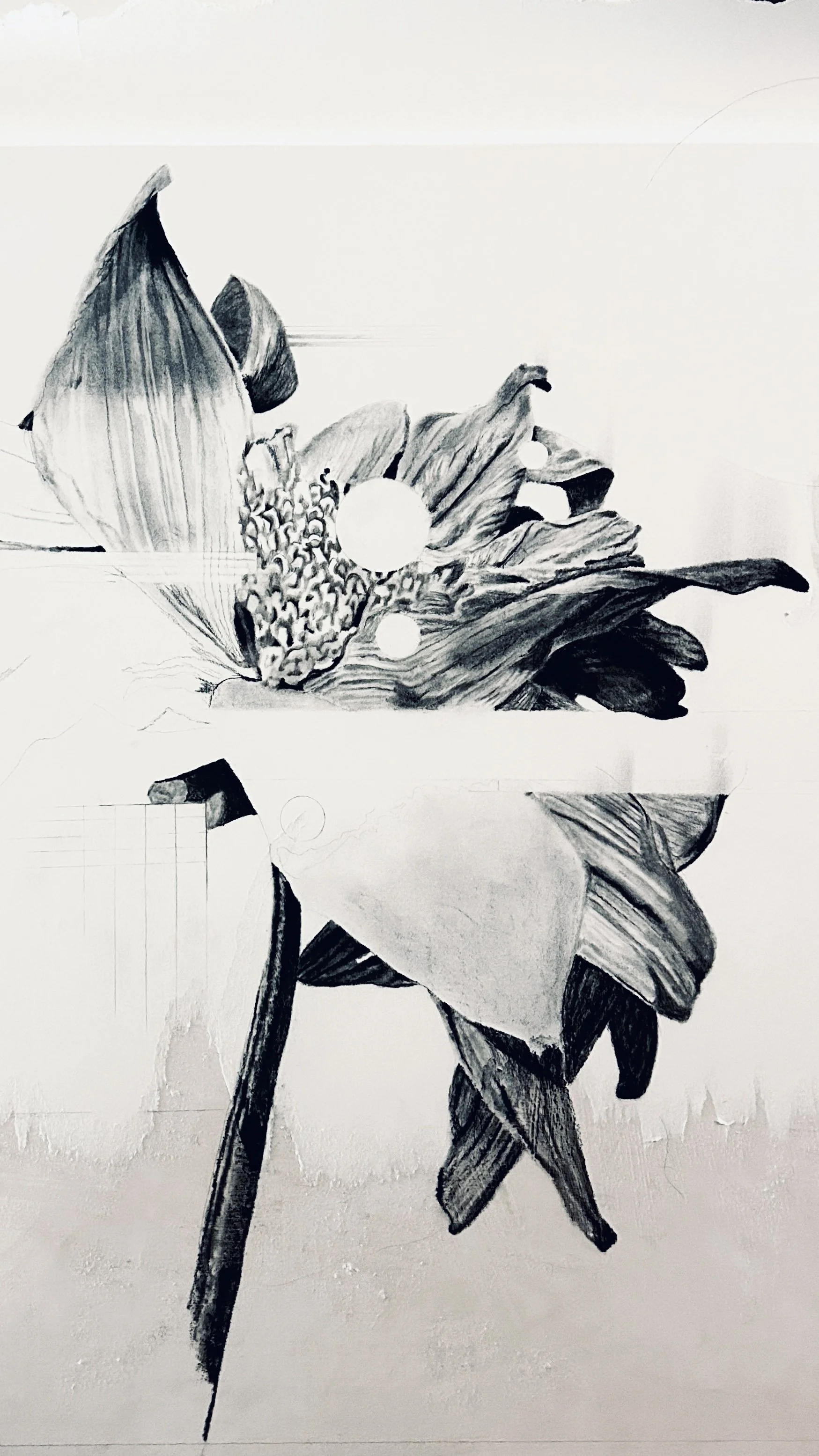
Deconstructed Still Life
This project reimagines the traditional still life by breaking familiar objects into fragmented, layered, and spatially shifted compositions. Rather than presenting a single fixed viewpoint, the drawings expose multiple moments of seeing at once - emphasizing perception as an active, constructed process. Ordinary objects are separated, rearranged, and partially abstracted, allowing form, negative space, and rhythm to become as important as representation.
Through this approach, the still life becomes less about preservation and more about inquiry. The work reflects how contemporary image culture fractures attention, while also proposing drawing as a slower, more deliberate counter-gesture. Each composition functions as both observation and intervention - a visual dismantling that invites viewers to reconsider how meaning is assembled through repetition, memory, and ritualized looking.
Abstracted colour with realism
This body of work merges precise realism with fields of abstracted colour to create tension between representation and sensation. While the drawn subject remains grounded in observational accuracy, colour operates as an emotional and spatial intervention - disrupting neutrality and introducing atmosphere, movement, and psychological depth.
Rather than using colour to describe surface alone, these works treat it as an active element that reshapes perception. Saturated forms, gradients, and overlays function as emotional markers, allowing inner experience to coexist with external likeness. Through this hybrid approach, realism becomes a foundation rather than a destination, opening space for interpretation, resonance, and visual ambiguity.
Fluid Mandalas
Fluid Mandalas draws from the symbolic structure of traditional mandalas while releasing it into motion, asymmetry, and organic flow. Rather than functioning as fixed geometric centers, these works unfold through layered colour, rhythm, and repetition, creating compositions that feel meditative yet dynamic.
The circular language of the mandala is treated as a starting point rather than a boundary. Forms dissolve, expand, and overlap, reflecting cycles of attention, breath, and internal movement. In this way, the work becomes both visual and experiential - inviting contemplation while resisting stillness.
Casted candle holders
This series of cast candle holders explores the boundary between functional object and sculptural form. Rooted in ritual use, the candle holder becomes both vessel and participant - holding light while shaping atmosphere, presence, and time. Through casting, everyday utility is translated into tactile, imperfect forms that emphasize material process, repetition, and hand-made variation.
Rather than prioritizing decoration alone, these objects are designed to be lived with. Their weight, texture, and subtle irregularities invite touch and use, allowing ritual to move from gallery space into domestic environments. In this way, the work bridges art and design, transforming functional objects into quiet sculptural anchors for daily acts of attention, reflection, and care.
Concrete Vases
This series of cast concrete vases explores the tension between permanence and fragility. Concrete, a material associated with infrastructure and durability, is reshaped into vessels traditionally linked to care, beauty, and domestic ritual. Through casting, the surface records subtle imperfections, air pockets, and texture - traces of process that emphasize the handmade within an industrial medium.
These objects function both as sculpture and utility. When holding flowers or standing empty, the vases participate in everyday rituals of offering, display, and attention. Their weight and solidity anchor them physically, while their form invites softness and presence. In this way, the work bridges art and design, transforming functional containers into material reflections on time, use, and the quiet ceremonies embedded in daily life.
Paper flower sculpture
This collection of paper flower sculptures explores fragility, impermanence, and care through handmade form. Using paper — a material associated with both preservation and transience - the flowers exist in a space between object and gesture. Each piece is shaped slowly by hand, emphasizing repetition, attention, and quiet labor as part of the creative process.
Unlike living flowers, these sculptures do not wilt, yet they retain a sense of delicacy and vulnerability. In this tension, the work reflects on how we ritualize beauty: through gifting, display, remembrance, and symbolic offering. The paper flower becomes both artifact and action — a record of time, touch, and intention.
Photo Edited Reconstructed Portraits
This series of drawings is based on digitally edited photographs that are fragmented, layered, and reconfigured before being translated by hand. By interrupting the traditional portrait structure, the work challenges the idea of a single, fixed likeness and instead presents identity as fluid, constructed, and continually shifting.
Through drawing, these altered images are slowed down and re-materialized, allowing digital distortion to become tactile and human again. The deconstruction process reveals gaps, overlaps, and moments of ambiguity, reflecting how contemporary identity is shaped by memory, mediation, and perception. In this way, the portraits move beyond representation and become spaces for inquiry - where presence is suggested rather than fully resolved.
For more information please sign up for the newsletter below. Thank you!